
 Back to List
Butcher’s broom, Box holly, Knee Holly, Jew’s myrtle
Scopia Regia [Royal Palace swept],
Parkinson, John (1640) 'Theatrum Botanicum' London, Thomas Cotes
Culpeper: ‘Of knee-holly ... provoke urine, break the stone, and help such as cannot piss freely. Use them like grass roots.’
Culpeper, Nicholas. (1650). A Physical Directory . London, Peter Cole.
Culpeper’s source for this information is Dioscorides, who says of this plant ‘... ye leaves and berries drunk in wine have ye force to move urine, expel the menstrua, and to break ye stones in ye bladder ...’ and adds also ‘ ... it cures also ye Icterus and ye strangurie and ye headache.’
Gunther, R.T. (1938). The Greek Herbal of Dioscorides ... Englished by John Goodyear.
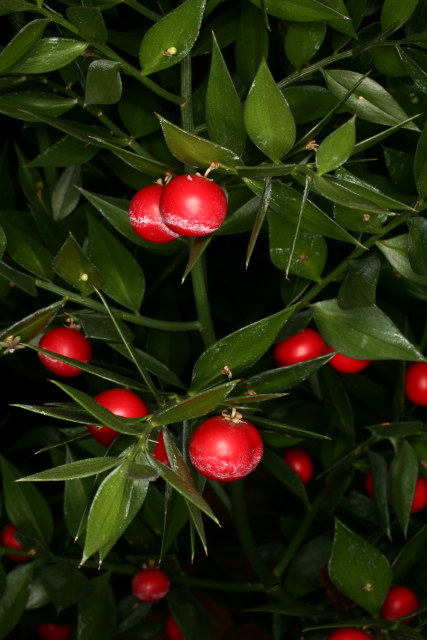
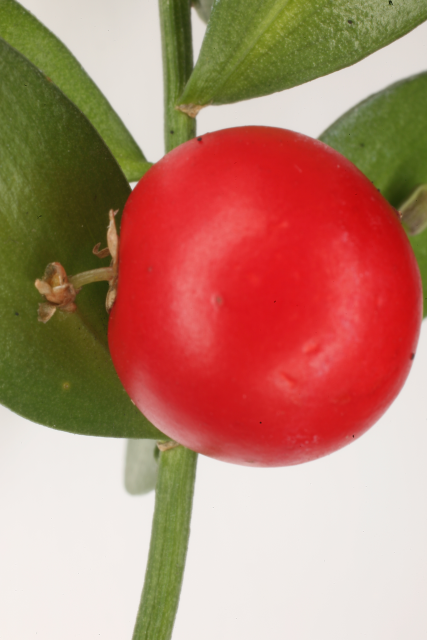
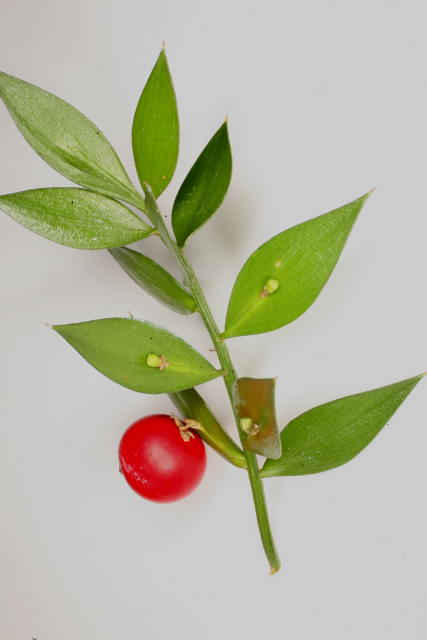
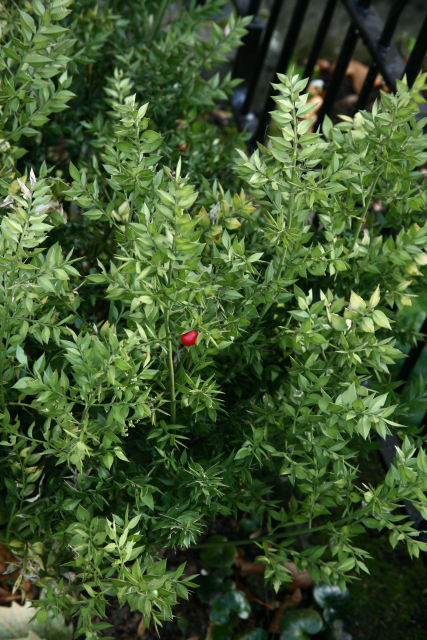
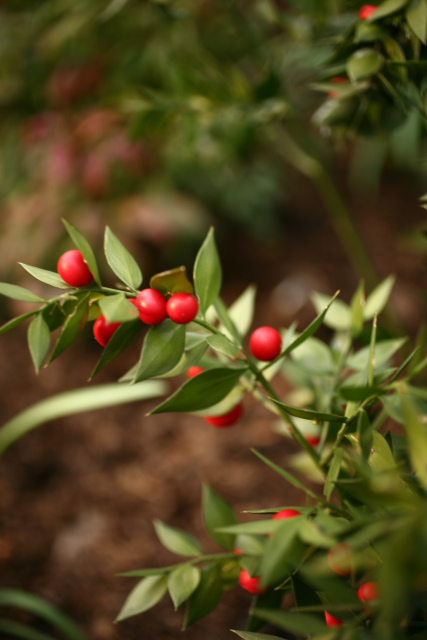
Ruscus aculeatus L. Ruscaceae Butchers Broom., Box holly, Knee Holly, Jew’s myrtle. Distribution: Mediterranean to Britain. Aculeatus means 'prickly' which describes the plant well. Dioscorides in 70 AD (Gunther, 1959) says of this plant ‘... ye leaves and berries drunk in wine have ye force to move urine, expel the menstrua, and to break ye stones in ye bladder ...’ and adds also ‘ ... it cures also ye Icterus and ye strangurie and ye headache.' Its use did not change for a millennium and a half; Culpeper (1650) 'Of knee-holly ... provoke urine, break the stone, and help such as cannot piss freely.’ However, a century or so later Linnaeus (1782) uses it for 'Hydrops ! Ascites, Icterus' [cardiac failure, abdominal distension due to fluid, and jaundice]. However modern herbals on the internet (2013) say it is now used for haemorrhoids, increasing peripheral blood flow and varicose veins. It is not licensed for use in the UK for the manufacture of herbal medicines and the European Medicines Agency Evaluation of Medicines for Human Use (September 2008) was critical of clinical studies, noted contact dermatitis and allergic dermatitis from topical use and diarrhoea and lymphocytic colitis from oral use, and lack of genotoxicity studies. It permitted it for 'traditional use' for relieving the symptoms of varicose veins (heavy legs) and the itching and burning associated with haemorrhoids, only. We can find a cryptic comment in Parkinson (1640) on the English name: Quoting Virgil (translated) 'the rough Ruscus, in woods and river banks, yeilds switches [brooms]' and comments 'to make Broomes to sweepe the house, from whence came the name Scopia Regia [Royal Palace swept], but the King's chamber, by revolution of time turned to the Butchers stall, for that a bundle of stalks tied together, serveth them to clense their stalles, and from thence we have our English name, Butchers Broome.' The thick 'leaves' are phylloclades, expanded stems, as one can see the flowers, and the red berries, arising from their surface. As such they contain chlorophyll in the cells on both surfaces which improves photosynthetic function, but have fewer stomata - it needs some for carbon dioxide exchange - so lose less water and tolerate drought well. It is licensed for use in Traditional Herbal Medicines in the UK (UK Medicines and Healthcare Products Regulatory Agency (MHRA)).
Oakeley, Dr. Henry F. (2013). Wellcome Library notes. Link
Indication: relieve symptoms of discomfort and heaviness of the legs related to minor venous circulatory disturbances; relief of itching and burning associated with haemorrhoids. Licensed for use in Traditional Herbal Medicines in the UK (UK Medicines and Healthcare Products Regulatory Agency (MHRA)).
Medicines and Health Care Regulatory Authority, 2013 Licensed Traditional Herbal Remedies
Side effects/precautions: Hypersensitivity; do not take if pregnant, breast feeding; may cause nausea, gastrointestinal complaints, diarrhoea, lymphocytic colitis From Patient information leaflet for preparations licensed as Traditional Herbal remedies in the UK
Medicines and Health Care Regulatory Authority, 2013 Licensed Traditional Herbal Remedies
Rare allergy due to ruscogenins.
Professor Anthony Dayan, 2021
HTA guide to Potentially Harmful Plants 2022: 'Humans/Pets: Fruit are ornamental - not to be eaten'
HTA Guide to Potentially Harmful Plants, 3rd Edition (2022)
Asia-Temperate, Western Asia, Turkey
Europe, Middle Europe, Hungary
Europe, Southeastern Europe, Albania
Europe, Southeastern Europe, Yugoslavia
Europe, Southeastern Europe, Greece
Europe, Southeastern Europe, Italy
Europe, Southwestern Europe, France
Europe, Southwestern Europe, Portugal
Europe, Southwestern Europe, Spain
.JPG)


