 Back to List
Other Common names: ALISANDERS;BLACK LOVAGE;BLACK POT-HERB;HORSE PARSLEY;STANMARCH;THANET CELERY
The genus name is said to derive from Smyrna, a city which was founded by Alexander the Great (although there was one which pre-dated his Smyrna). on the Aegean coast of Anatolia. The species name comes from the Latin olus meaning a pot herb (cooking vegetable) and atrum meaning black, in reference to the seeds.
Oakeley, Dr. Henry F. (2013). Wellcome Library notes. Link
This is a truly ancient vegetable, brought to England by the Romans, but now a hedgerow weed in many parts of Britain. Olus means a ‘pot herb’ or vegetable; atrum means black, referring to the black seeds. The name is derived from Smyrna, a city in western Turkey founded by Alexander the Great (356–323 BC) from whom it reputedly gains its common name. Theophrastus noted that the sap was bitter and tasted like myrrh. The leaves and stalks should be boiled and eaten with fish, and the roots pickled or served raw as a salad, according to Dioscorides. The leaves are like celery and the roots like parsnips, according to Mabberley. Lindley reported it as good for flatulence. Culpeper recommended it as a diuretic, for expelling the placenta, ‘opening a stoppage of the liver and spleen’ (whatever this might mean) and for snake bite.
Oakeley, Dr. Henry. (2011). A Year in the Medicinal Garden of the Royal College of Physicians, revised edition. Royal College of Physicians, London. page 41 Link
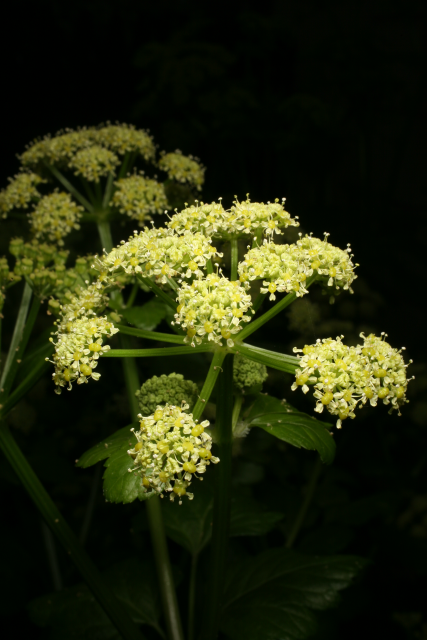
Smyrnium olusatrum L. Apiaceae. Alexanders, Black Lovage, Horse Parsley. Distribution: W & S Europe, Mediterranean. Culpeper (1650) writes: ‘Hipposelinum. Alexanders or Alisanders, provoke urine, expel the afterbirth, provoke urine, help the strangury, expel the wind.’ Culpeper has taken this mainly from Dioscorides’ Materia Medica (circa 70 AD). The genus name is said to derive from Smyrna, a city which was founded by Alexander the Great (although there was one which pre-dated his Smyrna). on the Aegean coast of Anatolia. The species name comes from the Latin olus meaning a pot herb (cooking vegetable) and atrum meaning black, in reference to the seeds. It is described as tasting like a rather bitter, second-class celery. The English name may derive from Alexandria or Alexander the Great. It is rarely used in herbal medicine now.
Oakeley, Dr. Henry F. (2013). Wellcome Library notes. Link
Africa, Macaronesia, Canary Is.
Africa, Northern Africa, Algeria
Africa, Northern Africa, Morocco
Africa, Northern Africa, Tunisia
Asia-Temperate, Western Asia, Cyprus
Asia-Temperate, Western Asia, Israel
Asia-Temperate, Western Asia, Jordan
Asia-Temperate, Western Asia, Lebanon-Syria
Asia-Temperate, Western Asia, Turkey
Europe, Southeastern Europe, Albania
Europe, Southeastern Europe, Greece
Europe, Southeastern Europe, Italy
Europe, Southwestern Europe, France
Europe, Southwestern Europe, Portugal
Europe, Southwestern Europe, Spain