 Back to List
Tanaceti in Pharmacopoeia Londinensis (1618 (2nd edit), Tansy and Tanacetum vulgare in Parkinson (1640)
Parkinson, John (1640) 'Theatrum Botanicum' London, Thomas Cotes page 80-81
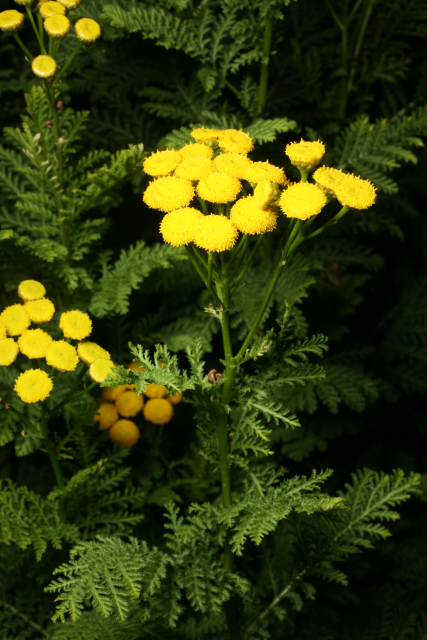
Notes by Henry Oakeley from Lindley's 'Flora Medica' (1838): This is the common Tansy; its other Latin name is Pyrethrum tanacetum. Lindley records that ‘Withering says that if meat is rubbed with Tansy leaves, the fleshfly will not touch it’. It contains an insecticide Pyrethrin, which is effective against many insect pests which is why the flies did not lay their eggs on Withering’s piece of meat. It is relatively harmless to mammals. Tanacetum cinerariifolium is the main source of Pyrethrin.
Lindley, John. (1838). Flora Medica, Longman, Orme, Brown, Green & Longmans
In traditional medicine Tansy has been a commonly grown domestic remedy, useful in treating a wide range of complaints, though it is little used in modern herbalism[Grieve, Mrs M. (1931). A Modern Herbal, Penguin. Leyel, Mrs CF]. Its main value is as a vermifuge to expel intestinal worms and, to a lesser degree, to help stimulate menstrual bleeding[Chevallier. A. The Encyclopedia of Medicinal Plants Dorling Kindersley. London 1996]. Tansy should be used with caution, however, it is possibly unsafe for internal use, especially if you are pregnant[Bown. D. Encyclopaedia of Herbs and their Uses. Dorling Kindersley, London. 1995]
https://pfaf.org https://pfaf.org/user/Plant.aspx?LatinName=tanacetum+vulgare
Asia-Temperate, Caucasus
Asia-Temperate, China
Asia-Temperate, Eastern Asia, Japan
Asia-Temperate, Eastern Asia, Korea
Asia-Temperate, Middle Asia, Kazakhstan
Asia-Temperate, Middle Asia, Kyrgyzstan
Asia-Temperate, Mongolia, Mongolia
Asia-Temperate, Russian Far East
Asia-Temperate, Siberia
Asia-Temperate, Western Asia, Turkey
Europe