 Back to List
Violaria
Culpeper, Nicholas. (1650). A Physical Directory . London, Peter Cole.
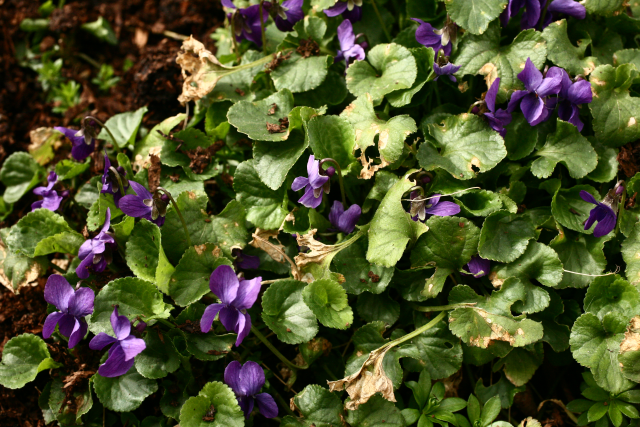
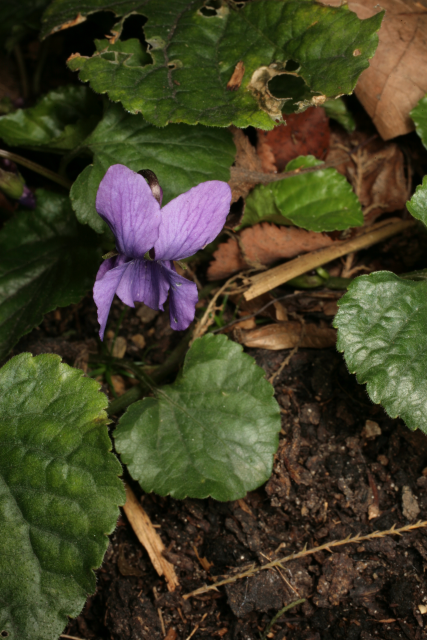
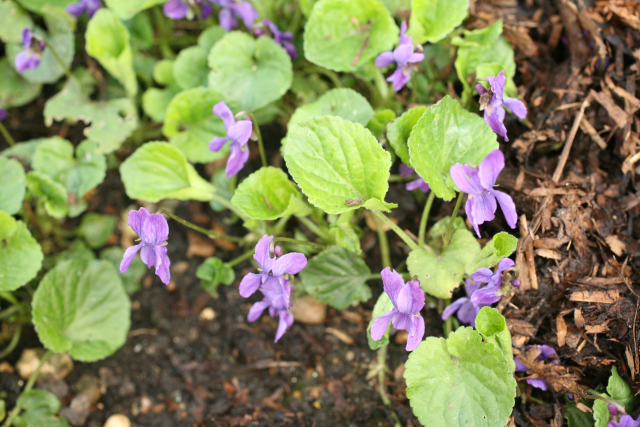
Some of our Viola odorata are double flowered. The IPNI have no record of a botanical name for the double flowered form (although a number of double flowered cultivars have been named such as 'Bethan Davies'. The name Viola odorata flore-pleno is not a valid botanical name (RHS).
Culpeper: “Violets (to whit the blew ones, for I know little or no use of the white ones in physic) ... provoke sleep, loosen the belly, resist fevers, help inflammations, ... ease pains in the head, help the roughness of the windpipe, soreness in the throat, inflammations in the breast and sides, pleurisies, open stoppings of the liver and help the yellow jaundice.” Culpeper: ‘Violaria. Violet leaves; they are cool, ease pains in the head arising from heat, and frenzies, either inwardly taken or outwardly applied, heat of the stomach or inflammation of the lungs.’
Culpeper, Nicholas. (1653). The London Dispensatory.
We also grow the ornamental double form. Dioscorides mixed the leaves with crushed barley to make a plaster for heartburn, inflamed eyes, and anal prolapse, and used the flowers for sore throats and epilepsy in children. Herbal medicines were used to treat countless different ailments, and in Chinese herbal medicine this belief persists. Violets remained very popular for a multitude of treatments in the 16th and 17th centuries, later writers noting that they caused diarrhoea. Crushed violets applied to the head were advised for ‘Melancholy, and dullnesse and heavinesse of the Spirite’; and the seeds, drunk in wine, against the stinging of scorpions, by Lyte. One wonders how many scorpion stings occurred in England in the 16th century. The seeds are toxic causing severe gastroenteritis, with respiratory and circulatory depression, so best avoided even if one is stung by a scorpion. The blue-coloured syrup of the flowers can be used like litmus paper according to Woodville, turning pink with the addition of acid and turning to green with alkali.
Oakeley, Dr. Henry. (2011). A Year in the Medicinal Garden of the Royal College of Physicians, revised edition. Royal College of Physicians, London. p.29 Link
Large quantities make one vomit.
Oakeley, Dr. H. F. . (2013). The Gardens of the Pharmacopoeia Londinensis. Link
Africa, Macaronesia, Canary Is.
Africa, Macaronesia, Madeira
Asia-Temperate, Western Asia, Cyprus
Asia-Temperate, Western Asia, Iran
Asia-Temperate, Western Asia, Iraq
Asia-Temperate, Western Asia, Lebanon-Syria
Asia-Temperate, Western Asia, Turkey
Asia-Tropical, Indian Subcontinent, India
Europe, Eastern Europe
Europe, Middle Europe
Europe, Northern Europe
Europe, Northern Europe, Great Britain
Europe, Southeastern Europe
Europe, Southwestern Europe