
 Back to List
Culpeper: “... comforts the heart, cheers the spirit, drives away sadness and melancholy, they are rather laxative than binding; help swooning and heart qualms, breed special good blood; help consumptions, madness and such as are much weakened by sickness”. He also writes “Borage and Bugloss flowers strengthen the heart and brain and are profitable in fevers.”
Culpeper, Nicholas. (1653). The London Dispensatory. London
It is (or was) added to Pimms, along with oranges and cucumber etc., but Culpeper was referring to it cheering the human spirit. Under Bugloss, Culpeper notes ‘Buglossum. Buglos, its vertues are the same as Borage’ with a margin note that ‘In Sussex (because they must be francified [=rendered into French]) called Languedebeef; in plain English Oxtongue.’
Culpeper, Nicholas. (1653). The London Dispensatory. London
Lindley, while noting its cucumber flavour and that it was added to cordials, doubted that it had any ‘exhilarating qualities’. He wrote that it ‘was once esteemed as a pectoral medicine.’
Lindley, John. (1838). Flora Medica, Longman, Orme, Brown, Green & Longmans
There is a video by Dr Henry Oakeley
Videos from the garden Link
It has been suspected of being hepatotoxic when taken internally and is genotoxic and carcinogenic. It should not be taken internally (MCA, 2002).
Medicines and Health Care Regulatory Agency , MCA. (2002). Medicines and Health Care Regulatory Agency (MHRA) for restricted or prohibited herbal medicines. Medicines and Health Care Regulatory Agency . Link
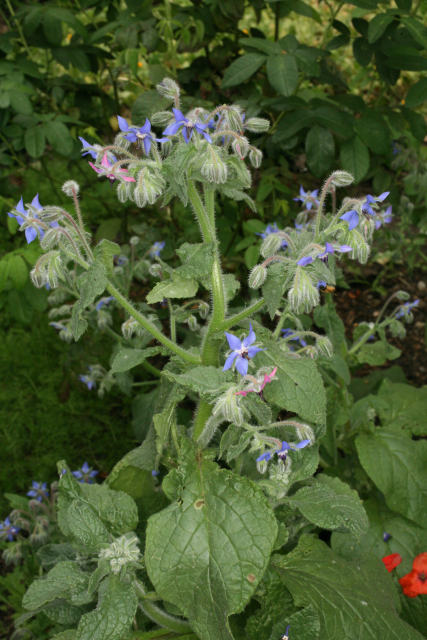
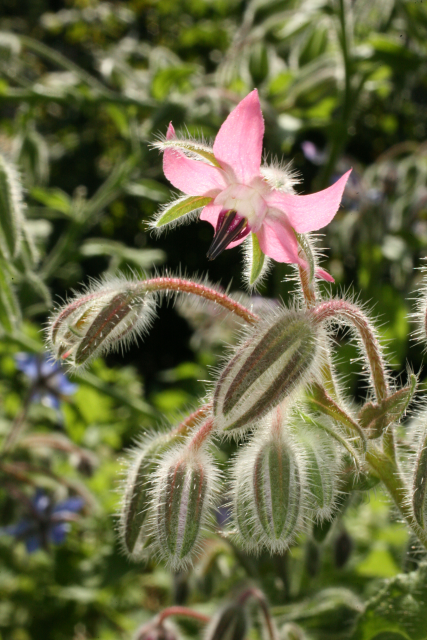
Borago officinalis L. Boraginaceae. Borage. officinalis indicates it was used in the 'offices' - the consulting clinics - of medieval monks. Distribution: Europe. Culpeper: “... comforts the heart, cheers the spirit, drives away sadness and melancholy, they are rather laxative than binding; help swooning and heart qualms, breed special good blood; help consumptions, madness and such as are much weakened by sickness” and the flowers 'strengthen the heart and brain, and are profitable in fevers.' It is (or was) added to Pimms, along with oranges and cucumber etc., but Culpeper was referring to it cheering the human spirit. Under Bugloss, Culpeper notes ‘Buglossum. Buglos, its vertues are the same as Borage’ with a margin note that ‘In Sussex (because they must be francified [=rendered into French]) called Languedebeef; in plain English Oxtongue.’ Lindley, while noting its cucumber flavour and that it was added to cordials, doubted that it had any ‘exhilarating qualities’. He wrote that it ‘was once esteemed as a pectoral medicine.’ It has been suspected of being hepatotoxic, containing pyrrolozidines, when taken internally and is genotoxic and carcinogenic. It should not be taken internally (Medicines Care Agency, 2002).
Oakeley, Dr. Henry F. (2013). Wellcome Library notes. Link
Borage is not mentioned in Beck’s translation of Dioscorides but from the account of the properties it appears that the 16th century herbalists confusingly called it buglossum, a name now used for Anchusa italica. Good illustrations are worth a thousand words in identifying plants, especially when the latter are written in Greek or Latin. Ruellio illustrates borage, captioning it as buglossum, noting that the Greeks called it corago, which had been corrupted to borago. He states that Dioscorides wrote that a three-branched plant of borage with root and seed would cure a Tertian fever, and a four-branched plant a Quaternary fever; added to wine it was an aphrodisiac. This is not in Beck and does not sound like Dioscorides. Lyte follows Fuchs who regarded buglossum as the same as borage, writing that the fl owers and leaves put in wine ‘will cause men to be glad and merry, and driveth away all heavy sadness and melancholy’. It was formerly added to the alcoholic drink, Pimms, with oranges and cucumber. It is suspected of being hepatotoxic when eaten, and is genotoxic and carcinogenic. It should not be taken internally.
Oakeley, Dr. Henry. (2011). A Year in the Medicinal Garden of the Royal College of Physicians, revised edition. Royal College of Physicians, London. page 33 Link
'Boraginis' in the Pharmacopoeia Londinensis (1618).
Africa, Northern Africa, Algeria
Africa, Northern Africa, Libya
Africa, Northern Africa, Morocco
Africa, Northern Africa, Tunisia
Asia-Temperate, Western Asia, Cyprus
Asia-Temperate, Western Asia, Lebanon-Syria
Europe, Eastern Europe, Belarus
Europe, Eastern Europe
Europe, Northern Europe, Sweden
Europe, Southeastern Europe, Albania
Europe, Southeastern Europe, Greece
Europe, Southeastern Europe, Italy
Europe, Southwestern Europe, France
Europe, Southwestern Europe, Portugal
Europe, Southwestern Europe, Spain
.JPG)
.JPG)
.JPG)


