 Back to List
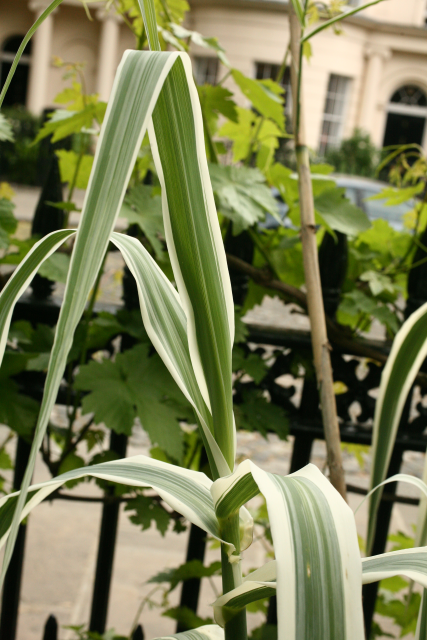
Syn. = Arundo donax 'Versicolor'
Prescription only medicine: lignocaine
Sodium ion channel blockade; GABA transaminase inhibitor. Contains gramine, from which lidocaine and other local anaesthetics were synthesised. Also used for controlling cardiac arrhythmias.
Oakeley, Dr. H.F. (2013). Medicines from RCP plants label list 5-2013.docx.
Lignocaine was synthesised from Arundo donax, (and also Hordeum vulgare - a form without chlorophyll), which contains gramine a bitter substance. From this isogramine was made which had weak local anaesthetic properties (the researchers tasted it !). From this lidocaine (aka lignocaine) was synthesised in 1943. Note: Completely synthetic drugs amylocaine (1903) and procaine (1904) antedated these plant-derived local anaesthetics. VERSATIN lidocaine patches for post herpetic neuralgia; LIDOCAINE im/iv Ventricular arrhythmias especially after heart attack; LIDOCAINE and numerous analogues, for local anaesthesia. ** Intravenous lignocaine has been used to abolish phantom limb pain. ** Cocaine was used as a local anaesthetic before the introduction of lignocaine, and had the serious disadvantage of occasionally causing cardiac arrest, as well as the problem of dependency and psychosis.
Oakeley notes: May 2014
Extracted from: Rev. Bras. Anestesiol. vol.52 no.3 Campinas May/June 2002 *** Arundo donax - By products: lidocaine (Löfgren & Lundquist, 1943) and tryptamine (von Euler, 1929). Achiralic lidocaine was synthesized as from the methylation of a grass byproduct which, “for being so bitter, was rejected even by camels” in Asian plateaus, namely isograss (the translator should have written isogramine). Clinically evaluated in the post-war period by Gordh (1947), lidocaine has become the prototype of new non histaminergic oral anesthetics - amino-amide group – with liver metabolism and more prolonged effects 11-13. REFS: Sten L - Xylocaine (lidocaine, lignocaine), its discovery and Gordh’s contribution to its clinical use. Acta Anaesthesiol Scand, 1998;42:(Suppl113):12. REFS: Gordh T - Xylocaine, a new local analgesic. Anaesthesia, 1949;4:4. REFS: Catterall WA, Mackie K - Local Anesthetics, em: Hardman JG, Limbird LE, Gilman AG - Godman & Gilman´s The Pharmacological Basis of Therapeutics, 10th Ed, New York, McGraw-Hill, 2001;367. REFS: Holmdahl MH - Xylocain (lidocaine, lignocaine), its discovery and Gordh's contribution to its clinical use. Acta Anaesthesiol Scand, 1998;113:8-12.
Rev. Bras. Anestesiol. vol.52 no.3 Campinas May/June 2002
Used to make the reed for oboes.
Oakeley notes: May 2014
.JPG)