 Back to List
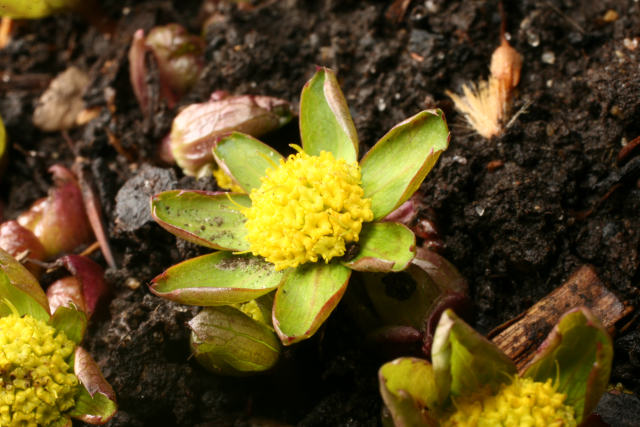
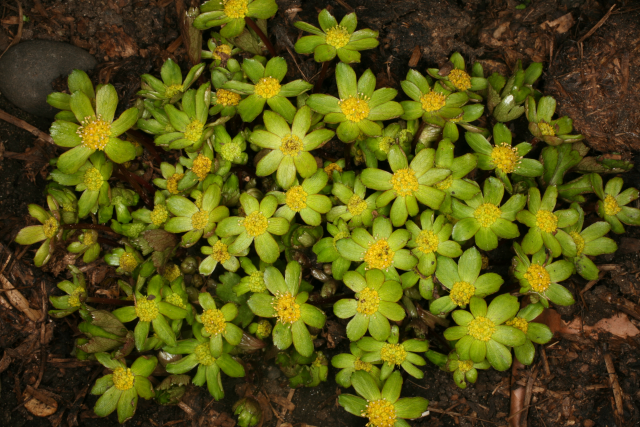
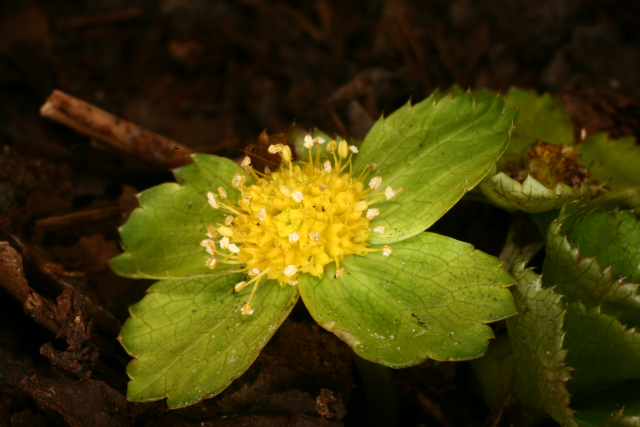
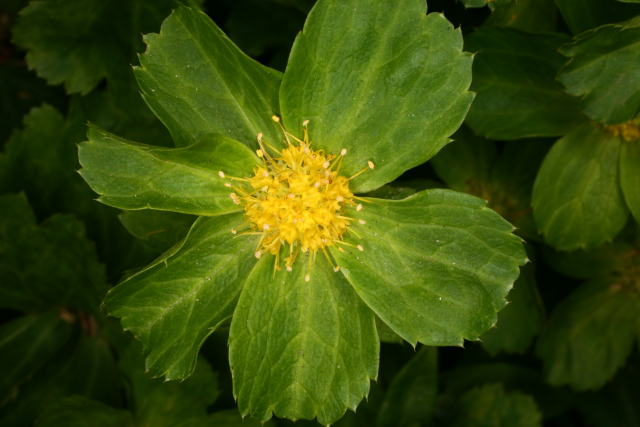
It is a member of the Apiaceae family, along with Cow Parsley, Anthriscus sylvestris, but easily distinguished by its tiny size with umbels of golden flowers a mere half centimetre across, nesting on a rosette of leaves. It has no medicinal or herbal usage, but is a pleasant addition to a rockery, flowering in January. Genetic studies show it is in a clade with (ie closely related to) Eryngium planum, Sanicula canadensis, and Astrantia major (Downie et al, 1998).
Oakeley, Dr. Henry. (2012). Doctors in the Medicinal Garden. Plants named after physicians. Royal College of Physicians. Link
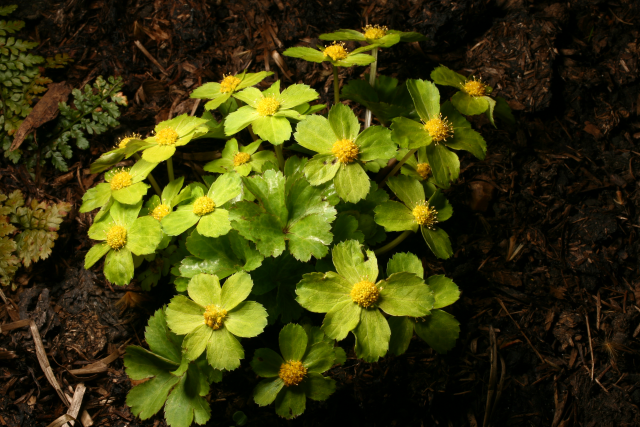
Sanicula epipactis (formerly Hacquetia epipactis) is a slow-growing, hardy perennial ranging from mid to south-east Europe in woodlands, bearing diminutive, yellow flowers in early spring. In the Medicinal Garden it survives in raised beds of fertile, moist soil in partial shade with a mulch of leaf mould. Protection from slugs and snails is sometimes required. It can be propagated by division in spring.(Clare Beacham)
Oakeley, Dr. Henry. (2012). Doctors in the Medicinal Garden. Plants named after physicians. Royal College of Physicians. Link
Parkinson (1640) grouped it with Helleborus and Veratrum, calling it 'Epipactis Matthioli, Matthiolus, his bastard black hellebore' but does not give any uses. It has no medicinal property.
Oakeley, Dr. Henry F. (2013). Wellcome Library notes. Link
This pretty little plant, with its golden flowers in late winter, was previously named Hacquetia epipactis after the Austrian physician, Balthasar (or Belsazar) Hacquet (1739/40–1815). He studied medicine in Vienna and was a surgeon in the brutal Seven Years War (1756–63) – a world-wide war in which up to 1,400,000 people died. Later he was professor at the University of Lemberg (1788–1810). He wrote widely on many scientific disciplines including geology. His botanical work on the alpine flora of Carniola (now part of Slovenia) was the slim 16-page Plantae alpinae Carniolicae (1782) with beautiful engravings, now exceedingly rare.
Oakeley, Dr. Henry. (2012). Doctors in the Medicinal Garden. Plants named after physicians. Royal College of Physicians. Link
Hacquetia epipactis is a synonym. 24/04/2020.
http://www.plantsoftheworldonline.org/
Europe, Middle Europe, Austria
Europe, Middle Europe, Poland
Europe, Middle Europe, Slovakia
Europe, Southeastern Europe, Czech Republic
Europe, Southeastern Europe, Italy