 Back to List
Fresh leaf juice allegedly beneficial in treating epilepsy.
Mabberley, D.J. (1997) The Plant Book, ed.2, Cambridge University Press p.188
This is a well-known medicinal plant in South Africa. The fleshy part of the leaf is applied to soften and remove hard corns and warts. The Southern Sotho use a dried leaf as a protective charm for an orphan child and as a plaything. In the Willowmore District, the heated leaf is used as a poultice for boils and other accessible inflammations, earache in particular . Van Wyk et al. (1997) report that a single leaf is eaten as a vermifuge and that the warmed juice can be used as drops for toothache or earache. They also report that the juice has been used to treat epilepsy.
PlantzAfrica.com. South African National Biodiversity Institute, South Africa. http://pza.sanbi.org/cotyledon-orbiculata
Toxic.
Mabberley, D.J. (1997) The Plant Book, ed.2, Cambridge University Press p.188
Toxic to domestic and farm animals due to bufadienolide alkaloid, cotlyledontoxin, that causes muscle spasms
Professor Anthony Dayan, 2022
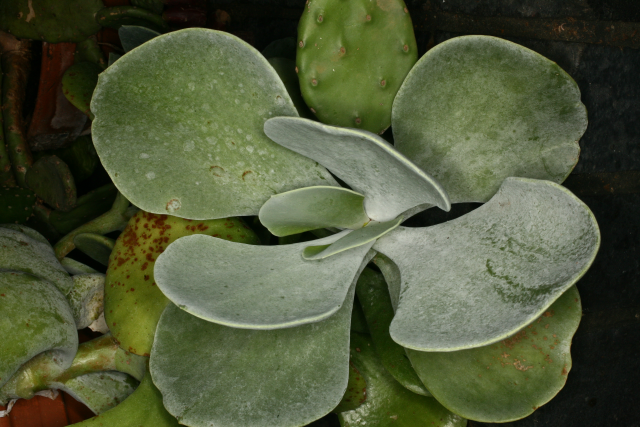
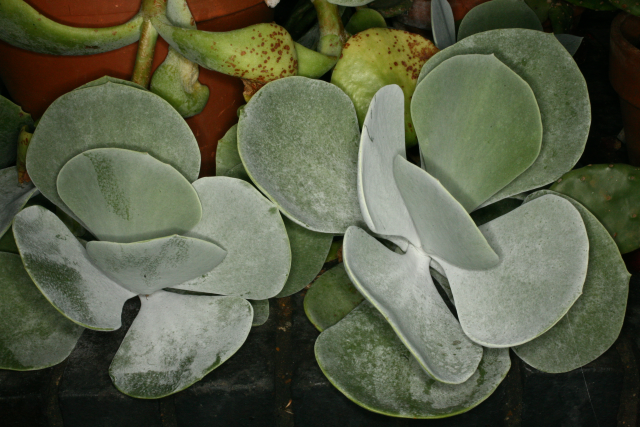
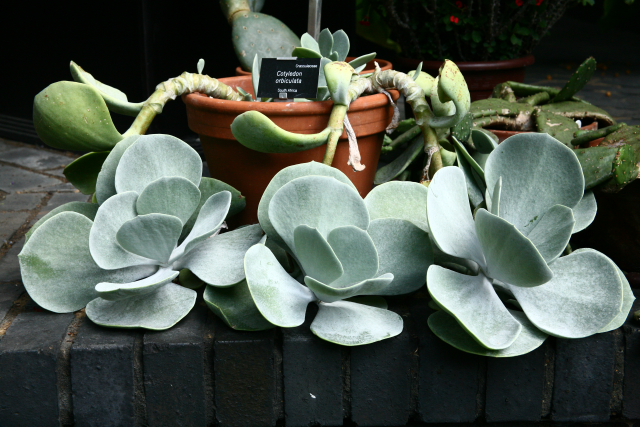
This succulent plant has thick leaves which may vary from green to grey, often with a red line around the margin. Cotyledon orbiculata has five varieties, based on differences in leaf and flower shape. The variability of leaf size, shape and colour is also influenced by the immediate environment. Selected forms in cultivation have been given names such as Elk Horns or Silver Waves. The colourful, hanging, tubular/bell-shaped flowers are carried in clusters on the ends of an elongated flower stalk. They are mostly orange-red , but yellow flowering forms are also occasionally found (Ernst van Jaarsveld pers. comm.).
PlantzAfrica.com. South African National Biodiversity Institute, South Africa. http://pza.sanbi.org/cotyledon-orbiculata
Africa, Southern Africa
.JPG)
.JPG)