
 Back to List
'Syrup of Figs’ was available, within living memory, as a treatment for constipation – and the figs themselves were recommended for this by both Dioscorides and Pliny the Elder. A use which has gone out of fashion since their time is applying the white sap to warts to soften and eventually remove them – in the same way as spurges are still used.
Oakeley, Dr. Henry. (2012). Doctors in the Medicinal Garden. Plants named after physicians. Royal College of Physicians. Link
Culpeper: ‘Green figs are held to be of ill juice, but the best of it is that we are not much troubled by them in England. Dry figs helps coughs, cleanses the breast, and help infirmities of the lungs, shortness of wind, they loose the belly, purge the reins, help infirmities of the liver and spleen; outwardly they dissolve swellings; some say the continual eating of them makes men lousie.’
Culpeper, Nicholas. (1650). A Physical Directory . London, Peter Cole.
Ficus- Latin name for the edible fig.
Stearn, W.T. (1996). Dictionary of Plant Names for Gardeners. Cassell. p.140
Car’ ica, specific epithet for fig, Ficus carica. The word also refers to Caria, a district in Asia Minor, where figs seem to have been extensively cultivated.
Stearn, W.T. (1996). Dictionary of Plant Names for Gardeners. Cassell. p.82
The fig has many biblical associations: most famously its leaves were used by Adam and Eve to clothe themselves after eating the forbidden fruit from the tree of knowledge of good and evil in the Garden of Eden.
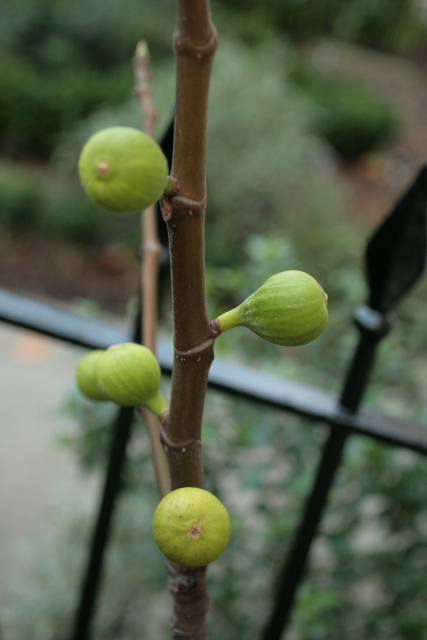
Deciduous, round tree or large shrub with a spreading head. Twigs stout, lightly hairy when young, become smooth and hairless with age. Latex runs from the stems when slashed. 3 or 5-lobed leaves, 10-24cm long, heart-shaped at the base. Pear-shaped receptacles (synconium) develop into a single "fruit", to 10cm long, green when young, maturing to dark green, purple or dark brown. Pollinated by fig wasps. Grows to 3m high by 4m wide or can be contained, happily, in pot. It is fully hardy.
Outdoors, grow in humus-rich, moist, well-drained soil in full sun or partial shade, with shelter from cold, drying winds. Take semi-ripe cuttings in summer. Figs can be attacked by mealybug or scale insects.
Brickell, C. (2003). A-Z Encyclopedia of Garden Plants. Dorling Kindersley. p.448
Beverage base, fruit.
The sap may cause photodermatitis as it has very high levels of furanocoumarins.
Africa, Northern Africa, Algeria
Africa, Northern Africa, Morocco
Africa, Northern Africa, Tunisia
Africa, Northern Africa, Egypt
Asia-Temperate, Western Asia, Afghanistan
Asia-Temperate, Western Asia, Cyprus
Asia-Temperate, Western Asia, Iran
Asia-Temperate, Western Asia, Iraq
Asia-Temperate, Western Asia, Sinai
Asia-Temperate, Western Asia, Lebanon-Syria
Asia-Temperate, Western Asia, Turkey
Asia-Temperate, Caucasus, Transcaucasus
Asia-Tropical, Indian Subcontinent, Pakistan
Europe, Southeastern Europe, Greece
Europe, Southeastern Europe, Italy
Europe, Southwestern Europe, France
Europe, Southwestern Europe, Spain
.JPG)
.JPG)
.JPG)


