
 Back to List
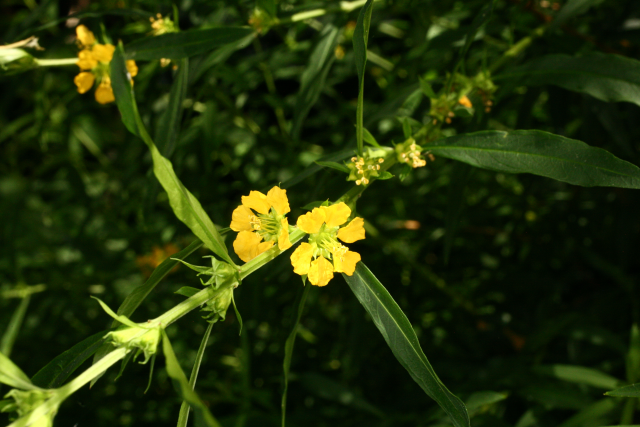
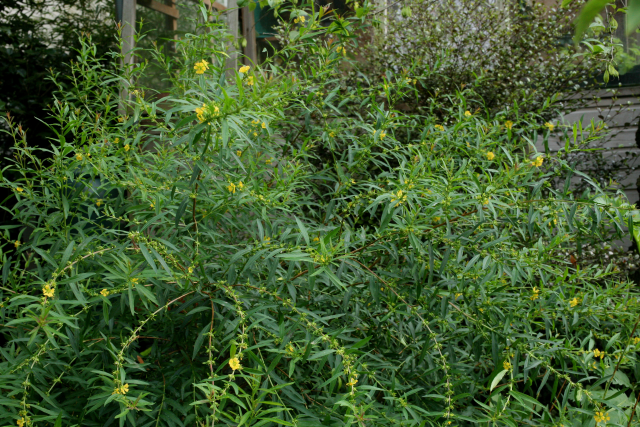
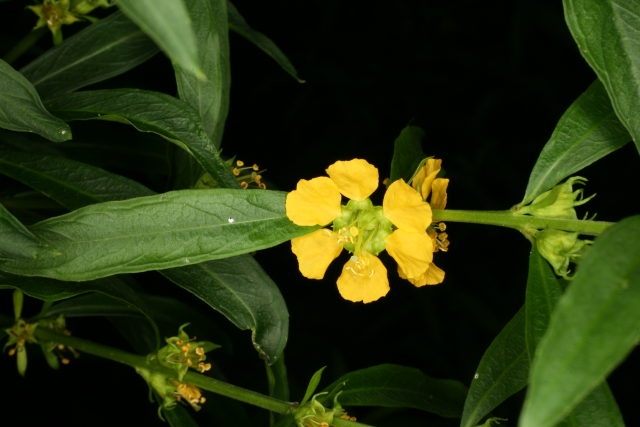
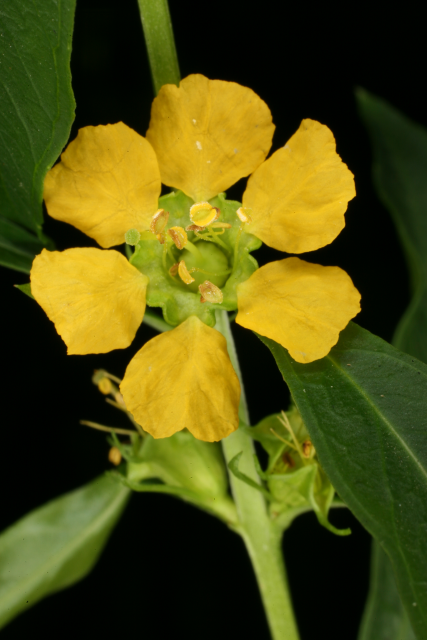
The willow-leaved Heimia in the family Lythraceae is a deciduous shrub found on river banks in southern USA, Mexico, Central America and the northern countries of South America. It bears numerous, bright-yellow flowers in late summer. It prefers a sheltered, sunny site with any well-drained soil. In severe winters, it may die back, but will recover from the base. A deep, bark mulch helps to protect it from frost.(Clare Beacham)
Oakeley, Dr. Henry. (2012). Doctors in the Medicinal Garden. Plants named after physicians. Royal College of Physicians. page 83 Link
This willow-leaved shrub with tiny yellow flowers is named after the German physician, amateur mycologist and botanist, Dr Ernst Ludwig Heim (1747–1834). He qualified from Halle and became a physician in Berlin, popular for treating the poor free of charge. He was the doctor to Queen Louise of Prussia and taught the eight-year-old Alexander von Humboldt (the great plant explorer in Latin America). His medical advice to avoid indoor work and spend as much time as possible in the open (Lloyd et al, 1996) to the hypochondriacal Christian Sprengel (1750–1816) resulted in that taxonomist’s career and his discovery (published 1793) that flowers are designed for the transmission of pollen by external vectors (eg insects and wind). Dr Heim is commemorated on a 1984 postage stamp.
Oakeley, Dr. Henry. (2012). Doctors in the Medicinal Garden. Plants named after physicians. Royal College of Physicians. Link
Heimia- named after German physician, Dr Ernst Ludwig Heim. salicifolia- willow-like leaf.
It is ‘used in fertility control and the crushed leaves, fermented and drunk, act as a mildly intoxicating hallucinogen’ which causes xanthopsia (everything appears yellow) (Mabberley, 2002). In Argentina it is used as an antisyphilitic, sudorific, antipyretic, laxative and diuretic. It contains numerous alkaloids, some of which have weak antiprostaglandin synthetase activity. The leaves, made into a tea, can damage the brain and induce visual and auditory hallucinosis, but it is extremely bitter and causes vomiting. It may (possibly) be known as 'sinucuichi' in Aztec herbalism.
Oakeley, Dr. Henry. (2012). Doctors in the Medicinal Garden. Plants named after physicians. Royal College of Physicians. Link
The leaves, made into a tea, can damage the brain and induce visual and auditory hallucinosis, but it is extremely bitter and causes vomiting.
Oakeley, Dr. Henry. (2012). Doctors in the Medicinal Garden. Plants named after physicians. Royal College of Physicians. Link
Toxic due mainly to hallucinogenic and other CNS effects
Professor Anthony Dayan, 2022
Northern America, South-Central U.S.A., New Mexico
Northern America, South-Central U.S.A., Texas
Northern America, Mexico, Mexico Northeast
Northern America, Mexico, Mexico Northwest
Northern America, Mexico, Mexico Southeast
Northern America, Mexico, Mexico Southwest
Southern America, Caribbean, Jamaica
Southern America, Central America, El Salvador
Southern America, Central America, Guatemala
Southern America, Brazil
Southern America, Western South America, Bolivia
Southern America, Southern South America, Argentina Northwest
Southern America, Southern South America, Argentina Northeast
Southern America, Southern South America, Paraguay
.JPG)


