
 Back to List
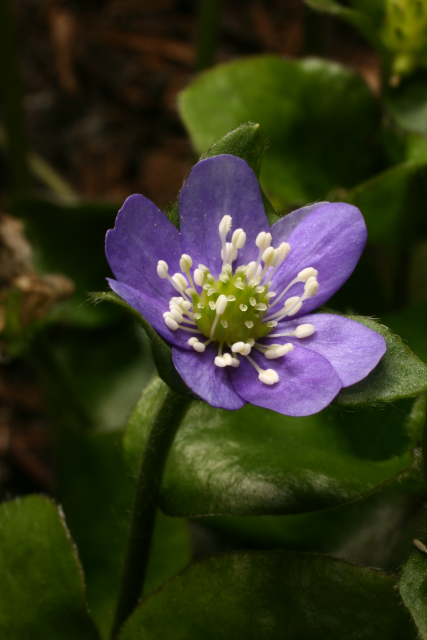
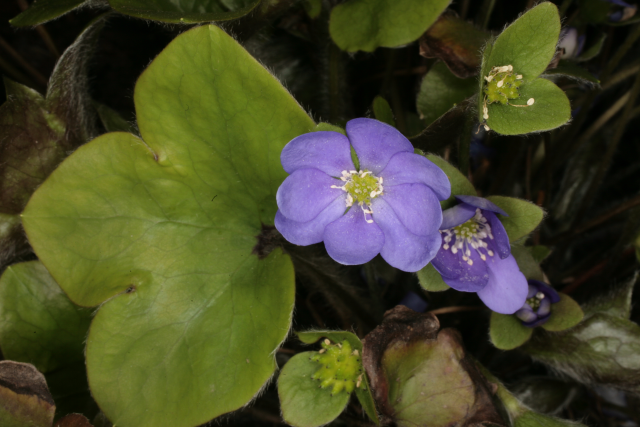
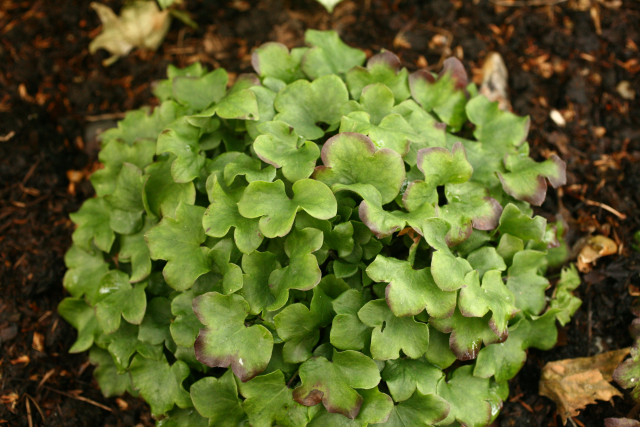
Hepatica nobilis Mill. Ranunculaceae. Liverwort - not to be confused with the lichen of the same name. Distribution: North America. Liverwort (‘liver plant’): discontinued herbal medicine for disorders of the liver.The name and the use to which the Liverworts have been put medicinally is suggested, according to the doctrine of signatures, by the shape of the leaves which are three-lobed, like the liver. It is little used in modern herbalism but was employed in treating disorders of the liver and gall bladder, indigestion etc. It is highly toxic. Hepatica acutiloba was widely used for liver disorders in the 1880s, with up to 200,000 kilos of leaves being harvested per annum to make liver tonics - which eventually caused jaundice. Gerard (1633) calls it Hepaticum trifolium, Noble Liverwort, Golden Trefoile and herbe Trinity and writes: 'It is reported to be good against weakness of the liver which proceedeth from a hot cause, for it cooleth and strengtheneth it not a little. ' He adds ' Baptista Sardus [fl. 1500] commendeth it and writeth that the chiefe vertue is in the root; if a spoonful of the pouder thereof be given certaine dayes together with wine, or with some kind of broth, it profiteth much against the disease called Enterocele.'
Gerard, John. (1975). The Herball or General History of Plants, Dover Publications Inc.. Johnson, Thomas. Facsimile 1633 ed
Gerard (1633) calls it Hepaticum trifolium, Noble Liverwort, Golden Trefoile and here Trinity.
Gerard, John. (1975). The Herball or General History of Plants, Dover Publications Inc.. Johnson, Thomas. Facsimile 1633 ed
Hepatica is the Greek word for the liver, and the three-lobed leaf of this little herbaceous plant with its bright blue flowers indicated, according to the Doctrine of Signatures, that it should be of value for the treatment of liver diseases as the liver has three lobes. Johnson calls it noble liverwort, or golden trefoile, Hepatica trifolium and herbe trinitie, to be used for ‘weakness of the liver’. Otherwise, it is not found in 16th- to 19th-century herbals or medical botany texts. Moerman reports that the Cherokee and Chippewa of North America used it for liver disorders and as a poultice for bruises, but much of their medical practice developed after the introduction of European ideas. Two hundred metric tons of dried Hepatica leaves were harvested in 1883 in Canada for liver tonics (immensely popular for treating ‘liverishness’, whatever that might be) which caused cases of jaundice. Perhaps the three-lobed leaf was a warning that it should not be used for the liver, but it is a member of the buttercup family, Ranunculaceae, so we should know it is toxic.
Oakeley, Dr. Henry. (2011). A Year in the Medicinal Garden of the Royal College of Physicians, revised edition. Royal College of Physicians, London. Link
Asia-Temperate, China
Asia-Temperate, Eastern Asia, Korea
Asia-Temperate, Russian Far East, Primorye
Europe, Eastern Europe, Belarus
Europe, Eastern Europe, Baltic States
Europe, Eastern Europe, Northwest European Russia
Europe, Eastern Europe, South European Russia
Europe, Eastern Europe, Ukraine
Europe, Middle Europe, Austria
Europe, Middle Europe, Germany
Europe, Middle Europe, Poland
Europe, Middle Europe, Slovakia
Europe, Middle Europe, Switzerland
Europe, Southeastern Europe, Czech Republic
Europe, Southeastern Europe, Albania
Europe, Southeastern Europe, Bosnia and Herzegovina
Europe, Southeastern Europe, Bulgaria
Europe, Southeastern Europe, Greece
Europe, Southeastern Europe, Italy
Europe, Southeastern Europe, Romania
Europe, Southeastern Europe, Yugoslavia
Europe, Northern Europe, Denmark
Europe, Northern Europe, Finland
Europe, Northern Europe, Norway
Europe, Northern Europe, Sweden
Europe, Southwestern Europe, France
Europe, Southwestern Europe, Spain
.jpg)
.JPG)


