 Back to List
An aqueous extract of the plant is a hand cleanser, making the skin soft and supple.
Plants for a Future (2015) at www.plantsforafuture.org.uk http://www.pfaf.org/user/Plant.aspx?LatinName=Herniaria+glabra
According to Mrs Grieve, Rupter Wort has very active diuretic properties, which have been found successful in the treatment of dropsy, whether of cardiac or nephritic origin. Folk medicine recommends it as a depurative.
Grieve, Mrs M. (1931). A Modern Herbal, Penguin. Leyel, Mrs CF p.697
Active ingredients: saponin, the glycoside herniarin, essential oil, tannins.
Launert, Edmund. (1981). Edible and Medicinal Plants of Britain and Northern Europe. The Hamlyn Publishing Group Ltd. p.42
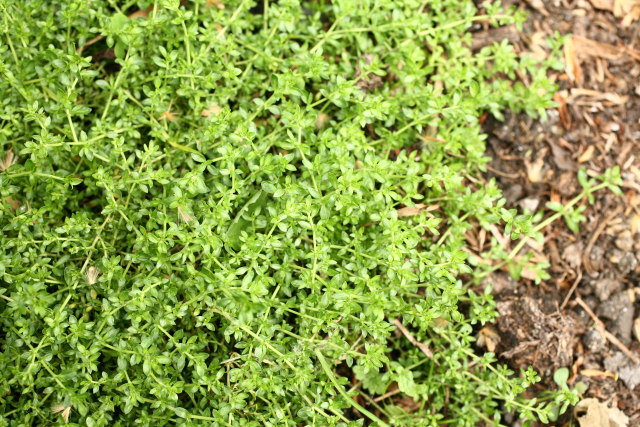
A slow growing, matt-forming, groundcovering annual or perennial with a tap-root. The shoots are numerous, prostrate, 5-30cm long, green, slightly hairy but glabrous, much-branched. The leaves are up to 1cm long (usually much shorter), ovate-lanceolate, acute, sometimes ciliate. The flowers are tiny, 1.8-2.2mm in diameter, regular, green and arranged in dense axillary clusters. Fruit is a nutlet, glossy, at first reddish then black, 5-6mm long, not opening. This plant is a British native, growing to 3cm high by 30cm wide.
Launert, Edmund. (1981). Edible and Medicinal Plants of Britain and Northern Europe. The Hamlyn Publishing Group Ltd. p.42
Grows well in hot dry soils. Dislikes excessive moisture. The leaves emit a musky smell when they are handled. Grow in fertile, humus-rich, well-drained soil in full sun. This plant can grow as groundcover or as an undershrub, in nutritionally poor soil and can tolerate some drought and strong winds. Sow seed at 13- 18°C in early spring, or in-situ in late spring. Pest and disease trouble free.
Plants for a Future (2015) at www.plantsforafuture.org.uk http://www.pfaf.org/user/Plant.aspx?LatinName=Herniaria+glabra
It is also called Smooth Rupture wort. The species name glabra means 'smooth' or 'hairless' referring to the leaves.
It was formerly used to treat hernias as well as cuts - herniated skin. In this capacity, it received its common name, Rupture wort.
In traditional medicine the whole plant is astringent, very actively diuretic and expectorant. It appears to have an antispasmodic effect upon the bladder and is used in the treatment of dropsy, catarrh of the bladder, cystitis and kidney stones. It has also gained a reputation for treating hernias. Externally, it has been used as a poultice to speed the healing of ulcers.
https://pfaf.org https://pfaf.org/User/Plant.aspx?LatinName=Herniaria+glabra
Africa, Northern Africa, Algeria
Africa, Northern Africa, Libya
Africa, Northern Africa, Morocco
Africa, Northern Africa, Tunisia
Asia-Temperate, Western Asia, Afghanistan
Africa, Northern Africa, Egypt
Europe, Southwestern Europe, Portugal
Europe, Southwestern Europe, Spain
Europe, Southeastern Europe, Albania
Europe, Southeastern Europe, Yugoslavia
Europe, Southeastern Europe, Greece
Europe, Southeastern Europe, Italy
Europe, Southeastern Europe, Romania
Europe, Southwestern Europe, France
Europe, Middle Europe, Poland
Europe, Middle Europe, Switzerland
Europe, Eastern Europe, Belarus
Europe, Eastern Europe, Baltic States
Europe, Eastern Europe, Ukraine
Europe, Eastern Europe, East European Russia
Europe, Middle Europe, Austria
Europe, Middle Europe, Belgium
Europe, Middle Europe, Czech Republic
Europe, Middle Europe, Germany
Europe, Middle Europe, Hungary
Europe, Middle Europe, Netherlands
Asia-Temperate, Middle Asia, Kyrgyzstan
Asia-Temperate, Middle Asia, Uzbekistan
Asia-Temperate, Middle Asia, Kazakhstan
Europe, Northern Europe, Denmark
Europe, Northern Europe, Sweden
Europe, Northern Europe, Great Britain
Asia-Temperate, Western Asia, Iran
Asia-Temperate, Western Asia, Lebanon-Syria
Asia-Temperate, Caucasus, Transcaucasus
Asia-Temperate, Siberia
Asia-Temperate, Middle Asia, Tadzhikistan