 Back to List
Culpeper: (1650)French Barly is cooling, nourishing and breeds milk.’
Culpeper, Nicholas. (1650). A Physical Directory . London, Peter Cole.
Notes: Barley water is a refreshing drink that was useful for thirst associated with diarrhoea and vomiting in cholera, according to Celsus (Jashemski).
Jashemski, W F . (1999). A Pompeian Herbal, Ancient and Modern Medicinal Plants. University of Texas Press.
Animal fodder, soil improver.
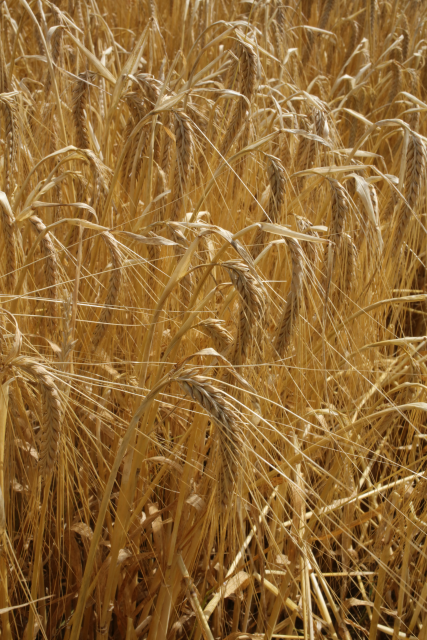
The main use for barley is beer production. 187,368,000 litres were consumed globally in 2012.
http://www.kirinholdings.co.jp/english/news/2014/0108_01.html
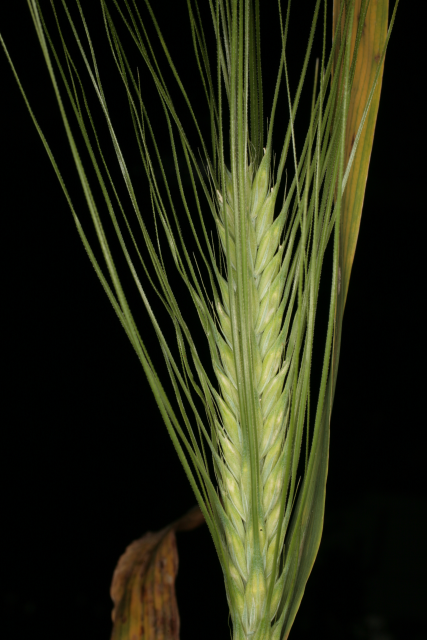
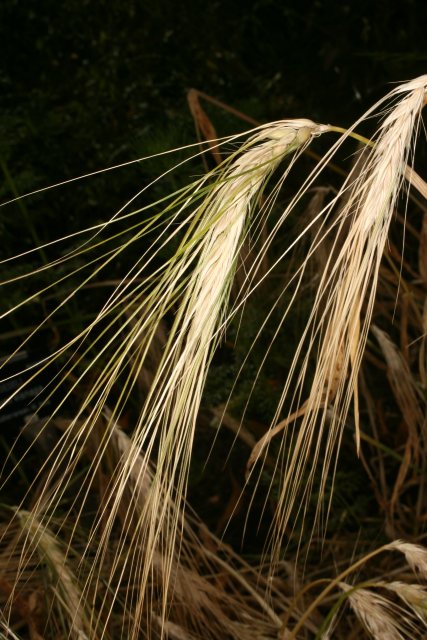
Cultivated barley is homozygous for a mutation (sometimes two) that prevents the seeds from separating ('shattering') and other mutations which increase the number of rows of seeds. "In traditional classifications of barley, these morphological differences have led to different forms of barley being classified as different species. Under these classifications, two-rowed barley with shattering spikes (wild barley) is classified as Hordeum spontaneum K. Koch. Two-rowed barley with nonshattering spikes is classified as H. distichum L., six-row barley with nonshattering spikes as H. vulgare L. (or H. hexastichum L.), and six-row with shattering spikes as H. agriocrithon Åberg. Because these differences were driven by single-gene mutations, coupled with cytological and molecular evidence, most recent classifications treat these forms as a single species, H. vulgare L."
http://en.wikipedia.org/wiki/Hordeum_vulgare Accessed 12 March 2014
Prescription only medicine: lignocaine
Hordeum vulgare Lignocaine. Hordeum vulgare, barley was the source of isogramine, synthesised by mistake when Erdtman, Hans von Euler's assistant in the 1930s was trying to make gramine as an nematocide. Erdman found that isogramine numbed his tongue and this led to the discovery of lignocaine, the local anaesthetic. In cardiovascular medicine lignocaine is given intravenously to treat arrhythmias.
William Harvey and plant derived medicines currently used in cardiovascular medicine, Prof Michael de Swiet's Notes 2018
See also 'Nomenclature' re the different species of barley, and that Hordeum distichum is the same as H. vulgare... Under H. distichum, it is noted that the six-row barley (which would be H. vulgare) is thought to be the barley of biblical times. Present in Egyptian heieroglyphs from 5000 BC and Sumerian cueiform tablets of 3,500 BC. Used as a currency in the code of Hammurabi in 1700 BC. Mentioned in the Bible, Exodus 9:31; Ezekiel 4:9 and Ruth 1:22. The classical Greeks had it as their major food source. In reign of Edward II (England) three grains of barley laid end to end made up the official inch (=2.5cm). WHile there were other methods of indicating the length of these measurements, 'the Israelites' ... [used] ... 'twenty-four barley corns' [presumably side by side] to measure a 'span' and forty-eight were 'a cubit'. A span is elswhere regarded as a hand span (thumb to little finger, outstretched) and a cubit was two spans or the distance from the tip of the middle finger to the point of the elbow.
Montague-Drake, Blair. (1977). A Biblical Herbal. Earth Images, Australia. p.28-29
Not itself toxic but can be infected by toxin- producing fungi, e.g. Aspergillus niger
Professor Anthony Dayan, 2022
Africa, Northern Africa, Egypt
Africa, Northern Africa, Libya
Asia-Temperate, Caucasus, Transcaucasus
Asia-Temperate, China
Asia-Temperate, Eastern Asia, Taiwan
Asia-Temperate, Middle Asia, Kyrgyzstan
Asia-Temperate, Middle Asia, Tadzhikistan
Asia-Temperate, Middle Asia, Turkmenistan
Asia-Temperate, Middle Asia, Uzbekistan
Asia-Temperate, Western Asia, Afghanistan
Asia-Temperate, Western Asia, Cyprus
Asia-Temperate, Western Asia, Iran
Asia-Temperate, Western Asia, Iraq
Asia-Temperate, Western Asia, Israel
Asia-Temperate, Western Asia, Jordan
Asia-Temperate, Western Asia, Lebanon-Syria
Asia-Temperate, Western Asia, Turkey
Asia-Tropical, Indian Subcontinent, India
Asia-Tropical, Indian Subcontinent, Pakistan
Europe, Southeastern Europe, Greece