 Back to List
Knautia macedonica Griseb. Dipsacaceae. Distribution: Macedonia. This honours the brothers Knaut, both physicians and botanists: Christof Knaut (also Knauth, 1638–94) and his brother Christian Knaut (1654–1716). The plant was traditionally used as a compress in its native Balkans to relieve dermatitis and itching. This use is a local survival of what was once a widespread application of this plant and its relations, and is an example of the doctrine of signatures in which the therapeutic benefit of a plant is suggested by some aspect of its anatomy; it has rough-textured leaves, so it was supposed to cure rough, itchy skin. It was locally called ‘Scabious’ and ‘Widow Flower’, the former because, like the genus Scabious, it was expected to cure scabies and itching (Oakeley, 2012)
Oakeley, Dr. Henry. (2012). Doctors in the Medicinal Garden. Plants named after physicians. Royal College of Physicians. Link
‘Scabious’ and ‘Widow Flower’
Oakeley, Dr. Henry F. (2013). Wellcome Library notes. Link
This honours the brothers Knaut: Christof Knaut (also Knauth, 1638–94) and his brother Christian Knaut (1654–1716). Christof Knauth was a German doctor, botanist, professor at Halle, and author of Enumeratio plantarum circa halam Saxonum ... sponte provenientium (1687). His brother Christian – author of Methodus plantarum genuina (1716), a pre-Linnaean classification of flowering plants – was also a botanist, physician and librarian. Christian studied medicine at the University of Leipzig and gained his doctorate from the University of Jena in 1682. He worked as the physician and librarian to Prince Manuel Lebrecht of Anhalt-Köthen. Christof was 16 years older than Christian, and some authors (eg Thomas, 1901) state that they were father and son. In the absence of birth certificates, I prefer to accept the fraternal relationship than to have Christian conceived when Christof was 15 years old.
Oakeley, Dr. Henry. (2012). Doctors in the Medicinal Garden. Plants named after physicians. Royal College of Physicians. Link
There is a video by Dr Henry Oakeley
Videos from the garden Link
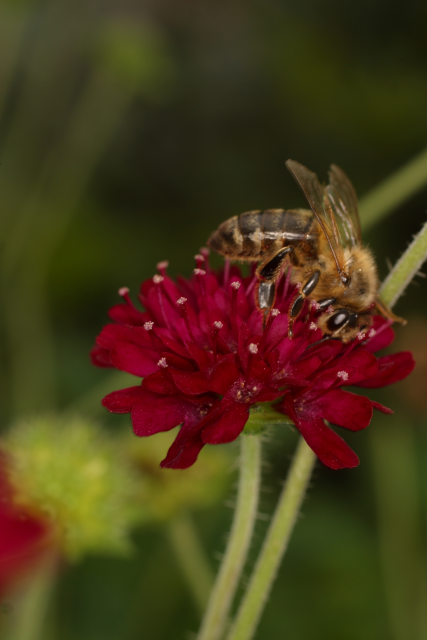
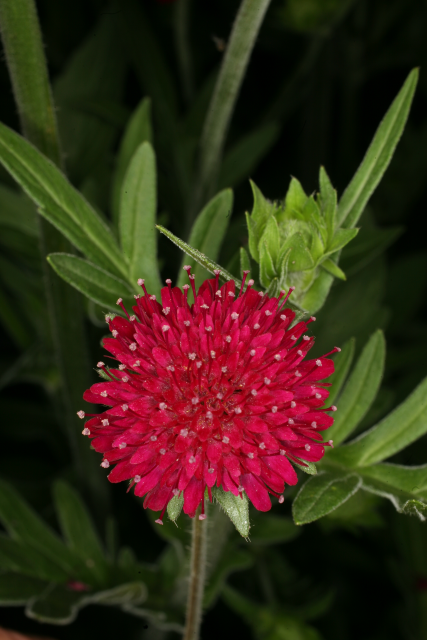
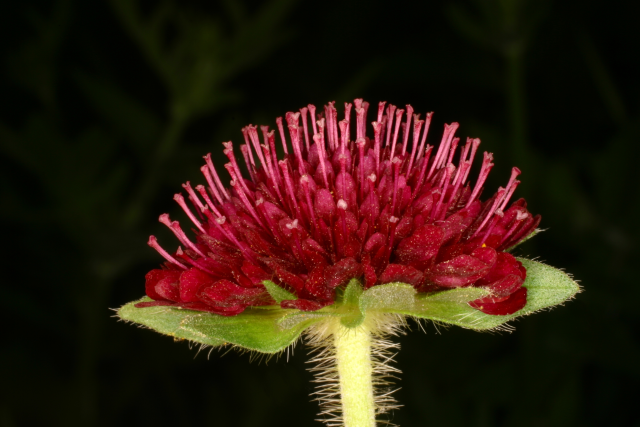
This fully hardy perennial in the family Caprifoliaceae hails from woods and scrub of central Europe. In the Medicinal Garden from July to September, its beautiful, deep-purple pompom fl owers mingle with other European wild fl owers in a warm, sunny, free draining border, where they are loved by bees and butterfl ies. Due to a sprawling habit, it benefi ts from staking in spring when the foliage begins to appear. A mulch of well-rotted manure is applied annually; it is watered during dry spells and cut down in autumn when the foliage begins to look untidy. (Clare Beacham)
Oakeley, Dr. Henry. (2012). Doctors in the Medicinal Garden. Plants named after physicians. Royal College of Physicians. Link
Europe, Middle Europe
.JPG)