 Back to List
Bee plant, animal fodder, soil improver, food additive
A legume whose root nodules fix nitrogen; the flowers are a honey source for bees; grown as a forage crop. It has become a major food source for American deer and elk, and is so widespread as to be rated a noxious weed in some areas. Horses, cattle and sheep have been poisoned by it.
http://www.fs.fed.us/database/feis/plants/forb/meloff/all.html (2010)
Culpeper (1649) ‘Meliotus. Meliot. Inwardly taken provokes urine, breaks the stone, clenseth the reins and bladder, cutteth and clenseth the lungs of tough phlegm; the juice dropped into the eyes cleers the sight, into the ears mitigates pain and noise there; the head bathed with the juice mixed with vinegar takes away the pains thereof, outwardly in poultices, it assuages swellings in the privities, and elsewhere.’
Culpeper, Nicholas. (1650). A Physical Directory . London, Peter Cole.
It is used as a vegetable and a flavouring (despite reports of toxicity), and, in herbal medicine, for the treatment of varicose veins and haemorrhoids where fresh leaves are recommended as the dry leaves are reported to be toxic (although it is not clear why this applies only to dry leaves).
Oakeley, Dr. H. F. . (2013). The Gardens of the Pharmacopoeia Londinensis. Link
“If you have ever doubted that pharmacologically potent compounds can be derived from plants, consider the history of warfarin. In the 1920s cattle in the Northern USA and Canada were afflicted by an outbreak of an unusual disease, characterised by fatal bleeding, either spontaneously or from minor injuries. Mouldy silage made from sweet clover (Melilotus alba and M. officinalis) was implicated, and L M Roderick in North Dakota showed that it contained a haemorrhagic factor that reduced the activity of prothrombin. However, it was not until 1940 that Karl Link and his student Harold Campbell in Wisconsin discovered that the anticoagulant in sweet clover was 3,3′-methylenebis(4-hydroxy coumarin) [1]. Further work by Link led in 1948 to the synthesis of warfarin, which was initially approved as a rodenticide in the USA in 1952, and then for human use in 1954. The name warfarin is derived from WARF (Wisconsin Alumni Research Foundation) and –arin from coumarin”
M. Pirmuhamed, Br J Clin Pharmacol. Nov 2006; 62(5): 509–511.
POM Warfarin
Horses, cattle and sheep have been poisoned by it.
http://www.fs.fed.us/database/feis/plants/forb/meloff/all.html
Possibly toxic but little information.
Professor Anthony Dayan, 2022
From seed- sow from spring to mid-summer in situ or in pots. Pre-soaking the seed for 12 hours in warm water will speed up the germination process, particularly in dry weather. Germination will usually take place within 2 weeks.
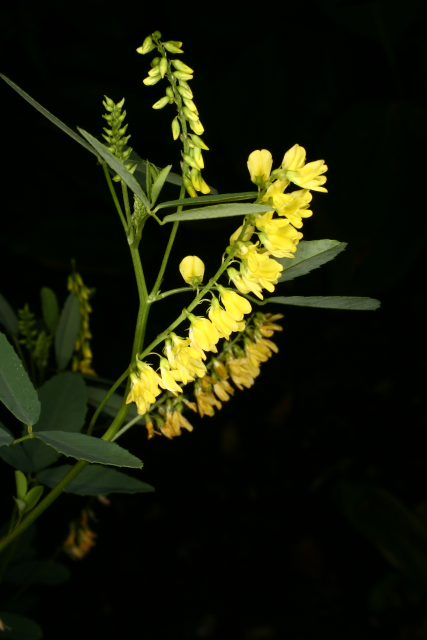
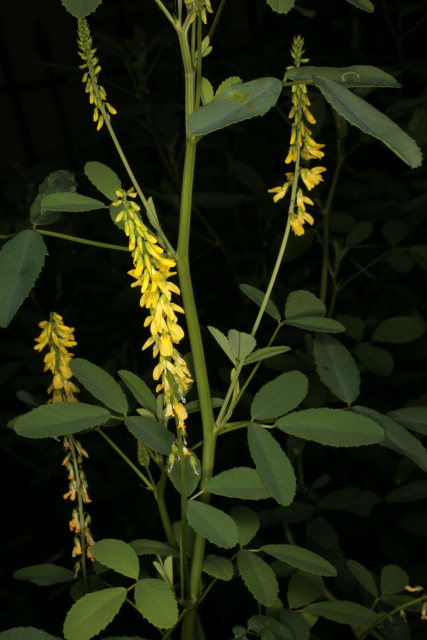
An erect, straggly, short-lived perennia or biennial, 60cm high, it has ridged, branched stems with trifoliate leaves and narrow ovate leaflets. The yellow honey-scented flowers are borne in slender axillary racemes, from mid-summer to autumn.
Bird, R, Houdret, J. (2000). Kitchen and Herb Gardener. Lorenz. p.412
In North America, infestations reduce the occurrence of natural fires and degrade native grassland communities that depend on frequent fires. In Alaska and Canada, this species is a serious problem on waterways because it is invading glacial river floodplains. Currently, it is recognized as a conservation problem in North America because it is invading critical natural areas such as national parks and protected lands. Like other nitrogen-fixing legumes, M. officinalis has the potential to alter soil conditions and nutrient cycling. It is allelopathic and so forms dense monospecific stands that displace and inhibit the establishment of native vegetation.
https://www.cabi.org/isc/about
OTHER COMMON NAMES: RIBBED MELILOT; BALSAM FLOWER; HART'S CLOVER; HEARTWORT; KING'S CLOVER; MELILOT; PLASTER CLOVER; SWEET CLOVER; WILD LABURNUM; YELLOW MELILOT; YELLOW SWEET CLOVER
The Royal Horticultural Society Horticultural Database, available at www.rhs.org.uk
Family name changed from Papilionaceae to Fabaceae. 05/01/2021. AT
http://www.plantsoftheworldonline.org/
The plant contains coumarin or dicoumarin, which converts to dicoumerol, an anticoagulant.
Oakeley, Dr. H. F. . (2013). The Gardens of the Pharmacopoeia Londinensis. Link
Asia-Temperate, Western Asia, Afghanistan
Asia-Temperate, Western Asia, Iran
Asia-Temperate, Western Asia, Iraq
Asia-Temperate, Western Asia, Turkey
Asia-Temperate, Caucasus
Asia-Temperate, Middle Asia, Kazakhstan
Asia-Temperate, Middle Asia, Kyrgyzstan
Asia-Temperate, Middle Asia, Tadzhikistan
Asia-Temperate, Middle Asia, Turkmenistan
Asia-Temperate, Middle Asia, Uzbekistan
Asia-Temperate, Russian Far East
Asia-Temperate, China
Asia-Tropical, Indian Subcontinent, Pakistan
Europe, Middle Europe, Austria
Europe, Middle Europe, Belgium
Europe, Middle Europe, Czech Republic
Europe, Middle Europe, Germany
Europe, Middle Europe, Hungary
Europe, Middle Europe, Netherlands
Europe, Middle Europe, Poland
Europe, Middle Europe, Switzerland
Europe, Eastern Europe, Belarus
Europe, Eastern Europe, Northwest European Russia
Europe, Southeastern Europe, Albania
Europe, Southeastern Europe, Bulgaria
Europe, Southeastern Europe, Yugoslavia
Europe, Southeastern Europe, Greece
Europe, Southeastern Europe, Italy
Europe, Southeastern Europe, Romania
Europe, Southwestern Europe, France
Europe, Southwestern Europe, Spain
.JPG)
.JPG)
.JPG)