 Back to List
OTHER COMMON NAMES:ANISE;BRITISH MYRRH;GARDEN MYRRH;GREAT CHERVIL;MYRRH;SWEET BRACKEN;SWEET CHERVIL;SWEET FERN;SWEET MARY; GARDEN Myrrh
The Royal Horticultural Society Horticultural Database, available at www.rhs.org.uk
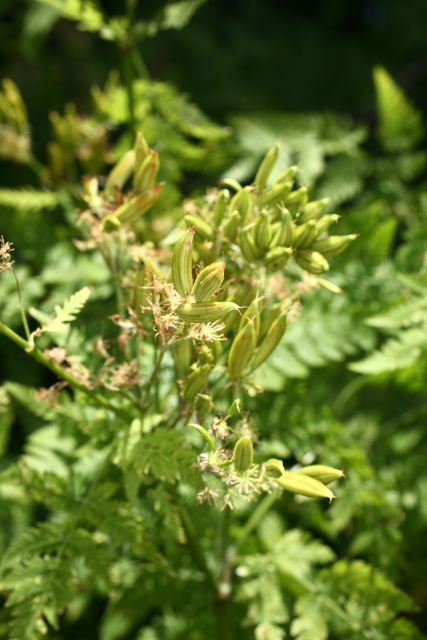
Culpeper: ‘Cerefolium vulgare & Myrrhis. Common and Great Chervil: take them both together and they ... provoke urine, stir up lust and the desire for copulation, comfort the heart and are good for old people, help pleurises and pricking in the sides.’ He adds (in his Complete Herbal and English Physician, 1826) with respect to Sweet Cicely ‘... leaves cut into divers parts, but of a fresher green colour than the hemlock, tasting as sweet as aniseed.’
Culpeper, Nicholas. (1826). Complete Herbal & English Physician, Magna Books. Facsimile 1826 ed.
Notes: This is in the Pharmacopoeia Londinensis as Myrrhis, but it is not clear if this is now known as Anthriscus sylvestris (Cow Parsley or Wild Chervil), or Myrrhis odorata (Sweet Cicely). This was the problem with names before Linnaeus, and the botanists that came after him, gave plants individual Latin names, the binomial (two name) system, starting in 1753. Both plants can be confused with hemlock, Conium maculatum, the source of the poison that killed Socrates (for a masterly account of the detective work that settled two millennia of debate on the subject see http://www.nd.edu/~plato/bloch.htm).
Oakeley, Dr. H. F. . (2013). The Gardens of the Pharmacopoeia Londinensis. Link
Trans-anethole, an alkenylbenzene, is carcinogenic, not genotoxic. Increased hepatocellular carcinoma secondary to hepatotoxicity in female rats over two year period.
van den Berg, S.J.P.L., Restani, et al., P.. (2011). Levels of Genotoxic and Carcinogenic Compounds in Plant Food Supplements and Associated Risk Assessment. Food and Nutrition Science 2: 989-1010. Link