
 Back to List
Dioscorides (Beck, 2005) regarded the olive as a panacea, curing all manner of cutaneous afflictions from shingles to sores; eye problems to bleeding and for cleaning gums, but the sap he regarded as a deadly poison, an abortifacient, but good for curing leprosy if applied topically. Other 16th century herbalists repeat Dioscorides but by Lindley’s time (1836) the bark had also acquired a reputation as a quinine substitute, so used for fevers. Its virtues have gradually descended to becoming an addition to salads and for lubricating ear wax, although the leaves are still used in herbal medicine. The great medicinal advantage of the oil is that ‘it does no harm’. Olive fruit takes much longer to ripen in northern latitudes, which is why we see it in mid-winter still on the tree at the Royal College of Physicians. It was presented to the College as a token of friendship by the Society of Apothecaries.
Oakeley, Dr. Henry F. (2013). Wellcome Library notes. Link
Traditionally it has been used as an antiseptic, aperient, astringent, diuretic, emollient, hair-oil, sedative, shampoo and tonic. It has been administered to relieve hypertension, fever and scrofula.
GRIN (Germplasm Resources Information Network) Taxonomy for plants. USDA Agricultural Research Service http://www.ars-grin.gov/cgi-bin/npgs/html/tax_search.pl
Oleae folium (leaves) and Olivae oleum (oil) have been used on scratches, psoriasis, treatment of wounds, lancing of boils and as a component of various medicines.
Petersen, F. (2012). Physic Garden Medicinal Plant Guide. Novartis Pharma AG. p.99
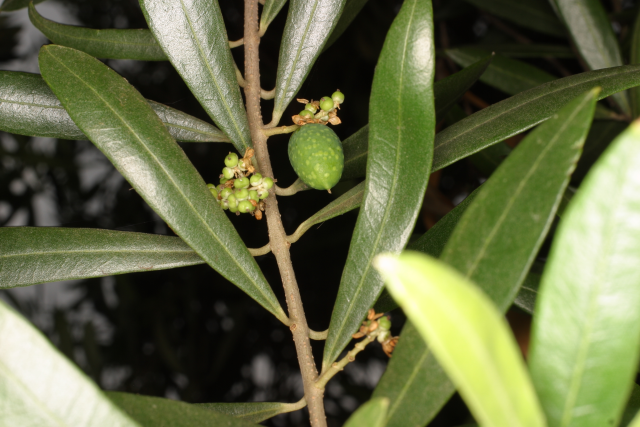
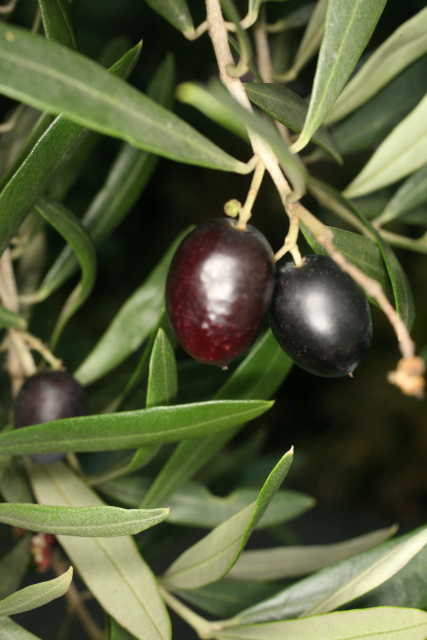
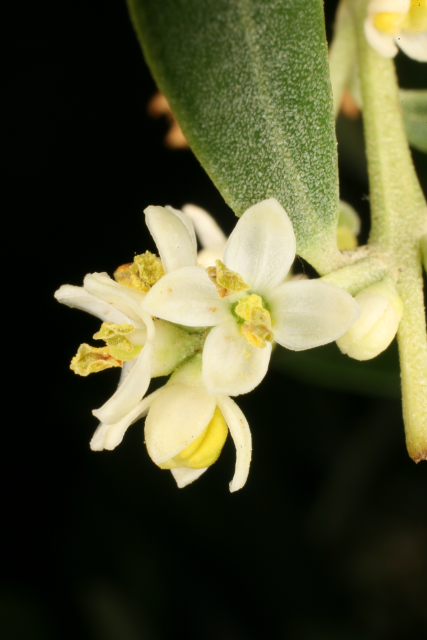
Slow growing, evergreen tree, developing a rounded head, with opposite, leathery, elliptic to lance-shaped, irregularly toothed leaves, to 8cm (3in) long, grey-green above, silvery grey-green beneath. Tiny, fragrant, creamy white flowers are borne in axillary panicles, to 5cm 2 (in) long, in summer, followed by edible, spherical ovoid green fruits (olives), to 4cm long, ripening to black. 10m (30ft) high by 10m wide. Frost hardy.
Brickell, C. (2003). A-Z Encyclopedia of Garden Plants. Dorling Kindersley. p.737
Grow in deep, fertile, sharply drained soil in full sun. During the growing season, water moderately and apply a balanced liquid fertilizer every month; water sparingly in winter.
Brickell, C. (2003). A-Z Encyclopedia of Garden Plants. Dorling Kindersley. p.737
To propagate: sow seed at 13-15°C in spring. Take semi-ripe cuttings in summer. Prone to scale insect infestations.
Brickell, C. (2003). A-Z Encyclopedia of Garden Plants. Dorling Kindersley. p.737
People held the olive tree and olive oil (ancient Greek, élaion, Latin oleum) to be sacred. From antiquity the tree has been a symbol of peace and good will. In Greek mythology, the olive tree was a gift of the goddess Pallas Athena to the city of Athens. This myth is understood today as a picture of how mankind became sedentry through the development of agriculture.
Petersen, F. (2012). Physic Garden Medicinal Plant Guide. Novartis Pharma AG. p.99
europea’us- european.
Stearn, W.T. (1996). Dictionary of Plant Names for Gardeners. Cassell. p.137
Oleuropein, which is found in virgin olive oil primarily, has among other things anti-oxidative, anti-inflammatory, vasodilative and antihypertensive effects. Oleuropein increases the proportion of the transmembrane protein thermogenin in the brown adipose tissue and triggers the release of adrenaline and noradrenaline. This generates heat without muscular activity and breaks down enriched body fat.
Petersen, F. (2012). Physic Garden Medicinal Plant Guide. Novartis Pharma AG. p.99
Contains iridoids (oleuropein), aclyglycerols with oleic acid.
Petersen, F. (2012). Physic Garden Medicinal Plant Guide. Novartis Pharma AG. p.99
Europe, Southwestern Europe, Portugal
Europe, Southwestern Europe, Spain
Africa, Northern Africa, Algeria
Africa, Northern Africa, Egypt
Africa, Northern Africa, Libya
Africa, Northern Africa, Morocco
Africa, Northern Africa, Tunisia
Africa, Northeast Tropical Africa, Ethiopia
Africa, Northeast Tropical Africa, Somalia
Africa, Northeast Tropical Africa, Sudan
Africa, East Tropical Africa, Kenya
Africa, East Tropical Africa, Tanzania
Africa, East Tropical Africa, Uganda
Africa, South Tropical Africa, Malawi
Africa, South Tropical Africa, Mozambique
Africa, South Tropical Africa, Zambia
Africa, South Tropical Africa, Zimbabwe
Africa, Southern Africa, Botswana
Africa, Southern Africa, Namibia
Africa, Southern Africa, KwaZulu-Natal
Africa, Western Indian Ocean, Madagascar
Africa, Western Indian Ocean, Mauritius
Africa, Western Indian Ocean, Réunion
Asia-Temperate, Arabian Peninsula, Saudi Arabia
Asia-Temperate, Arabian Peninsula, Yemen
Asia-Temperate, Western Asia, Cyprus
Asia-Temperate, Western Asia, Turkey
Europe, Southeastern Europe, Greece
Europe, Southeastern Europe, Italy
Europe, Southeastern Europe, Yugoslavia
Europe, Southeastern Europe, Albania
Europe, Southwestern Europe, France
.JPG)
.JPG)
.JPG)


