
 Back to List
Artemisia: after the Greek goddess Artemis who so benefitted from a plant of this family that she gave it her own name. This was also the old Latin name given to the mugwort or wormwoods. An alternative possibility for the derivation of this name is that it comes from Queen Artemisia of Halicarnassus in Asia Minor (Turkey), sister and wife of King Mausolus, who ruled after his death from 352 to 350 B.C.E. and built during her short reign one of the Seven Wonders of the Ancient World, the Mausoleum at Halicarnassus, which she unfortunately did not live to see the completion of. This is one of the many genera which Swedish botanist Carl Linnaeus published in his Species Plantarum in 1753 and is in the family Asteraceae.
http://www.calflora.net/southafrica/1A-B.html
Artemisia- named in honour of Artemis, the Greek goddess of chastity. Of considerable medicinal value, plants of the genus yield vermifuges, stimulants, and a vulnerary…
Stearn, W.T. (1996). Dictionary of Plant Names for Gardeners. Cassell. p.56
afra- african.
Stearn, W.T. (1996). Dictionary of Plant Names for Gardeners. Cassell. p.34
Artemisia afar has been used in natural insecticidal sprays and as a moth repellent.
Liesl van der Walt. 2004. Artemisia afra. [ONLINE] Available at: http://www.plantzafrica.com/plantab/artemisafra.htm. [Accessed 09 November 15]. http://www.plantzafrica.com/plantab/artemisafra.htm
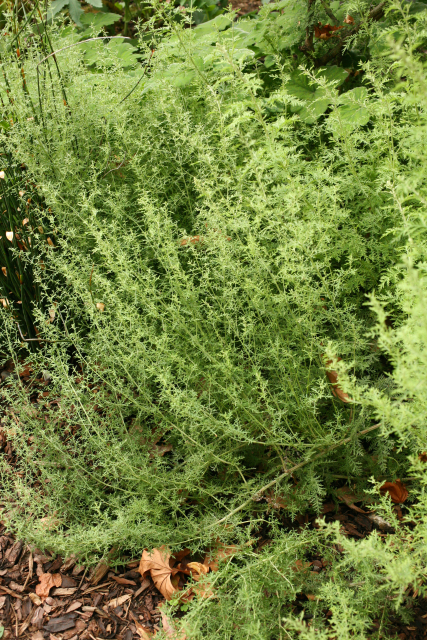
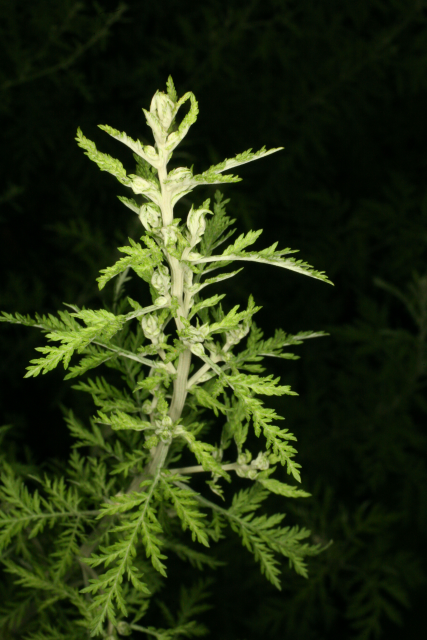
African wormwood grows in thick, bushy, slightly untidy clumps, usually with tall stems up to 2m (6.5 feet) high. The stems are thick and woody at the base, becoming thinner and softer towards the top. Many smaller side branches shoot from the main stems. The soft, silver grey leaves are finely divided. The upper surface of the leaves is dark green whereas the undersides and the stems are covered with small white hairs, which give the shrub the characteristic overall grey colour. It flowers in late summer. The individual creamy yellow flowers are small (3-4 mm in diameter), nodding and crowded at the tips of the branches. The foliage of this important African plant exudes a strong, sticky sweet smell when touched.
Liesl van der Walt. 2004. Artemisia afra. [ONLINE] Available at: http://www.plantzafrica.com/plantab/artemisafra.htm. [Accessed 09 November 15]. http://www.plantzafrica.com/plantab/artemisafra.htm
One of the oldest and best known medicinal plants. It is still used effectively today in South Africa by people of all cultures. The list of uses covers a wide range of ailments from coughs, colds, fever, loss of appetite, colic, headache, earache, intestinal worms to malaria. Artemisia is used in many different ways and one of the most common practices is to insert fresh leaves into the nostrils to clear blocked nasal passages. The roots, stems and leaves are used in many different ways and taken as enemas, poultices, infusions, body washes, lotions, smoked, snuffed or drunk as a tea. A. afra has a very bitter taste and is usually sweetened with sugar or honey when drunk. Wilde-als brandy is a very popular medicine still made and sold today.
Liesl van der Walt. 2004. Artemisia afra. [ONLINE] Available at: http://www.plantzafrica.com/plantab/artemisafra.htm. [Accessed 09 November 15]. http://www.plantzafrica.com/plantab/artemisafra.htm
Africa, Northeast Tropical Africa, Ethiopia
Africa, East Tropical Africa, Kenya
Africa, East Tropical Africa, Tanzania
Africa, East Tropical Africa, Uganda
Africa, West-Central Tropical Africa, Zaire
Africa, South Tropical Africa, Angola
Africa, South Tropical Africa, Malawi
Africa, South Tropical Africa, Mozambique
Africa, South Tropical Africa, Zambia
Africa, South Tropical Africa, Zimbabwe
Africa, Southern Africa, Botswana
Africa, Southern Africa, Lesotho
Africa, Southern Africa, Namibia
Africa, Southern Africa, Cape Provinces
Africa, Southern Africa, Free State
Africa, Southern Africa, KwaZulu-Natal
Africa, Southern Africa, Northern Provinces
Africa, Southern Africa, Swaziland
.JPG)


